Essay · June 18, 2026 · 6 min read
Are Human Conversations Special?
We measured how large language models pay attention to human dialogue versus web text, code, and math. Conversations turned out to be the domain models understand least on its own terms. Here is what we found, in plain English.
Here’s a fragment of an ordinary work conversation:
A: So did you get a chance to look at the…
B: The pricing thing? Yeah, no, I started, but then Priya said hold off because of the, you know, the thing from Tuesday.
A: The legal review.
B: Right. So it depends what she comes back with.
Any human colleague understands this instantly. “The pricing thing” resolves an unfinished question. “Yeah, no” means yes, I’ll explain. “The thing from Tuesday” points at shared history that never gets named until the next turn quietly repairs it. Who needs to do what next isn’t stated anywhere, it’s distributed across four turns and two speakers.
Now consider that large language models learn language mostly from text that looks nothing like this. Edited articles, documentation, books, code. Prose that one author wrote, revised, and linearized before anyone read it. Conversation is the opposite. It’s improvised, co-constructed, and full of repairs and references that reach backward across turns and speakers.
After years of building conversation understanding systems, I had a strong hunch that language models treat human dialogue like noisy prose, and that the mismatch was behind a whole family of production failures. In 2024 we put the hunch to the test in a paper that tried to turn it into a measurement. This essay is the plain-English version.
Watching where models look
When a language model processes text, its attention mechanism decides, for every token, which earlier tokens matter right now. Attention is not a perfect window into what a model understands, but it is a real, measurable trace of how the model spends its computation over the input. Where it looks, how widely, and how confidently.
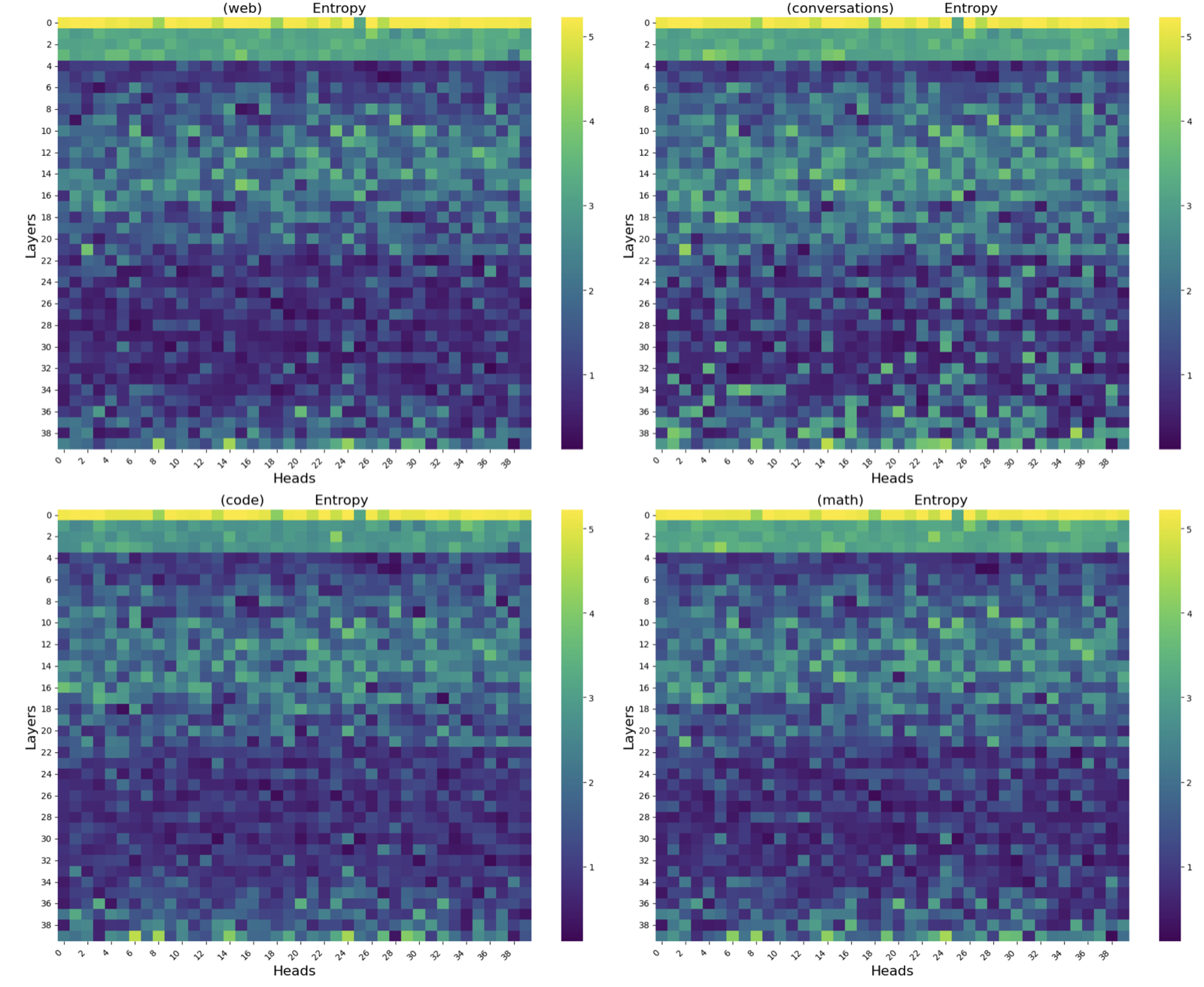
That gave us a way to ask the question empirically. Take the same models, feed them text from four domains, natural human conversations, web content, code, and mathematical text, and measure how the attention machinery behaves differently across layers. We looked at several properties:
- Attention distance, how far back in the context the model reaches when connecting tokens.
- Attention dispersion, whether attention concentrates on a few tokens or spreads across many.
- Interdependency, how attention heads relate to each other while processing the input.
- Entropy, how complex and uncertain the attention pattern is. Roughly, how hard the model has to work to decide what’s relevant.
Code and math are useful comparisons because they’re also unusual text with their own deep structure, and models visibly adapt to them. The question was whether conversation gets the same treatment.
What we found
Two findings matter most.
First, conversation is genuinely different, and the models can feel it. Processing human dialogue pushed attention toward longer-range and more dispersed patterns, with higher entropy, which is what you’d expect from input whose meaning depends on long-distance relationships rather than local phrase structure. It’s exactly what the transcript fragment above demands. Resolving “the thing from Tuesday” is a long-range, cross-speaker dependency, not a local one.
Second, models specialize for some domains, but not for this one. You can see the separation directly. Project the attention patterns for each domain and watch what happens as depth increases. Conversation pulls away into its own cluster, clearly distinct from the web text the model grew up on.
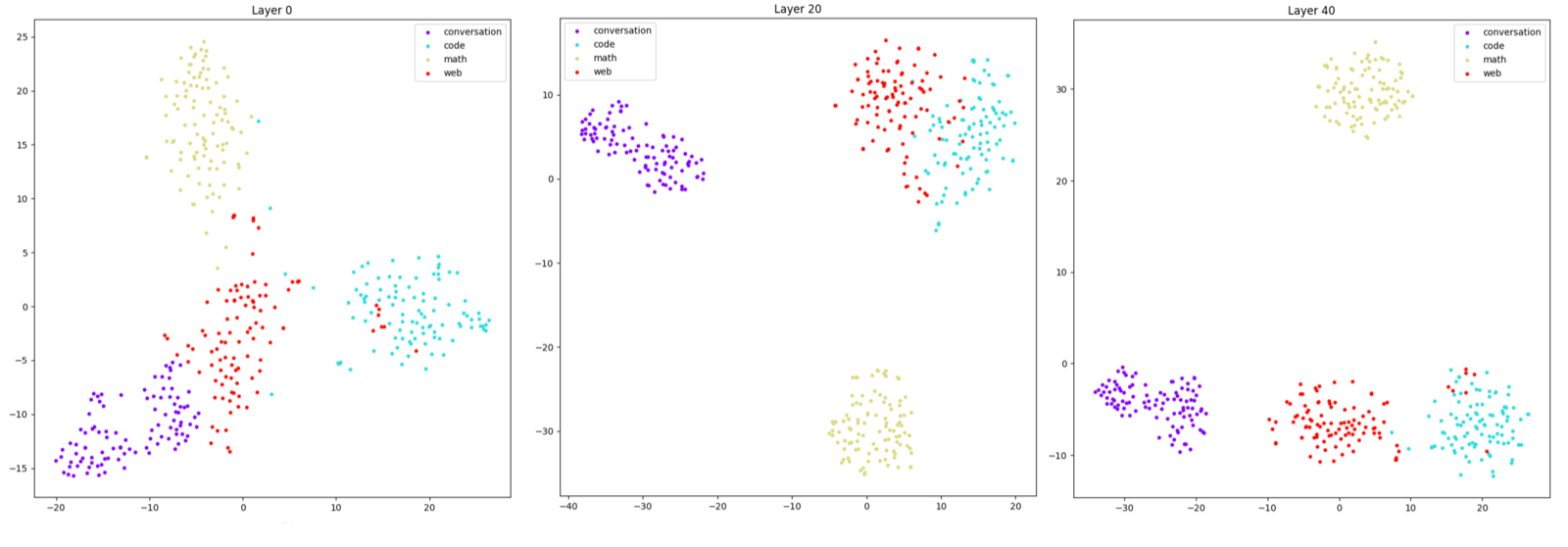
On code and math, attention shifts into recognizably distinct, domain-adapted patterns. The model has clearly internalized that these inputs have their own rules. On human conversation that specialization is much weaker. Models process dialogue mostly with their general-purpose web-text machinery, working harder and reaching farther, but without the dedicated structure they’ve developed for other domains. The specialization that shows up for code and math just isn’t there for conversation.
In short, yes, human conversations are special, and current language models seem to know it without being equipped for it.
Why dialogue resists models trained on prose
Once you look, the reasons are everywhere in how conversation actually works.
Meaning is co-constructed. No single speaker writes a conversation, and understanding turn four requires modeling what turns one through three established between people, including things agreed to implicitly.
Repair is constant. Humans revise mid-utterance, “we should ship Friday, actually no, Monday,” and listeners effortlessly keep the correction and discard the original. Written text almost never teaches this, because editing removes it before publication.
Reference is radically compressed. “That,” “the other one,” “what she said earlier.” Conversation is dense with pointers whose referents live many turns back, often in someone else’s mouth, and this is precisely the long-range dependency structure we saw attention straining toward.
And the channel is lossy. Real systems see conversation through speech recognition, which strips out prosody, the melody and timing that carried sarcasm, hesitation, and emphasis, and adds its own errors on top. In related work we showed how badly tone-blind reading distorts model behavior. Sarcasm that any human hears becomes literal fact to a model reading a transcript.
None of this is exotic. It’s every meeting, every support call, every standup. The most common form of human language is the one models are least prepared for.
Why this matters more in 2026 than it did in 2024
When the paper came out, voice agents were a promising demo category. Now they answer phones for real businesses, and everyone building in this space eventually runs into the same uncanny gap. Models that are brilliant at answering remain oddly clumsy at conversing. They lose the thread across turns, mishandle interruptions and repairs, and treat a caller’s “yeah, no, the other one” as noise instead of information.
Our results suggest that gap is not a bug you patch with prompts. It’s a structural property of what these models were trained on and how they’ve specialized. A few things follow from that.
-
Conversation-native data is the bottleneck. Models specialize where their training distribution lets them. High-quality, real, multi-party conversational data is scarce, sensitive, and expensive, which is exactly why the gap persists. Teams that hold such data, with the right to use it, hold something the frontier can’t easily replicate.
-
Evaluation has to be conversational too. Benchmarks built on questions and documents will keep telling us models are fine while they fail at dialogue. Whether the model tracked who committed to what across twelve messy turns is a different measurement than any QA score, and until we measure it, we won’t train for it.
-
Voice needs the lost channel back. As models go multimodal and speech-to-speech, prosody re-enters the loop, and much of what transcripts destroyed, the intent and tone and hesitation, becomes recoverable. Systems that treat conversation as a first-class modality rather than text with stage directions are going to feel categorically different to talk to.
The oldest interface
Conversation was the first interface humans ever had, older than writing by tens of millennia. It’s how we negotiate, decide, teach, and trust. And it’s quickly becoming the primary interface between humans and AI systems.
So the question in the title has an ironic edge. Of course human conversations are special, every human already knew that. What the measurement adds is that the specialness is visible inside the machines themselves. You can watch a language model working harder, reaching farther, and specializing less the moment people start actually talking. The models are telling us where they need help.
We should listen.